Netherlands Public Holidays: King's Day, Liberation Day and the Rules
Dutch law recognises a list of public holidays but does not oblige employers to give them off. King's Day and Liberation Day show how much depends on the collective agreement.
A new employee in Amsterdam asks whether 5 May is a day off. Their manager says "only every five years", a colleague in a government agency says "every year", and a friend in retail is working regardless. All three are right. In the Netherlands, the law says which days are public holidays, but whether you have the day off depends largely on your employment terms.
The recognised public holidays
Dutch law recognises the following days as public holidays for legal purposes, such as deadlines:
| Holiday | Date |
|---|---|
| New Year's Day (Nieuwjaarsdag) | 1 January |
| Good Friday (Goede Vrijdag) | Friday before Easter |
| Easter Sunday and Easter Monday | Variable |
| King's Day (Koningsdag) | 27 April, or 26 April if the 27th is a Sunday |
| Liberation Day (Bevrijdingsdag) | 5 May |
| Ascension Day (Hemelvaartsdag) | Thursday, 39 days after Easter Sunday |
| Whit Sunday and Whit Monday | Variable |
| Christmas Day and Boxing Day (Eerste en Tweede Kerstdag) | 25 and 26 December |
Good Friday is on the list, but relatively few employers give it as a day off. Liberation Day is also on the list, but often with a twist, covered below.
No statutory right to the day off
Unlike in some neighbouring countries, there is no general law in the Netherlands that obliges employers to give employees public holidays off, or to pay a premium for working on them. In practice, most employees do get the main holidays off, because their collective labour agreement (CAO) or employment contract says so. Where there is no CAO, the contract and company policy decide. Check your contract and local rules.
Holidays that fall on a weekend are not moved to a weekday. The one adjustment in the system is King's Day.
King's Day
King's Day celebrates the birthday of King Willem-Alexander, on 27 April. It has been held on that date since 2014; before that, Queen's Day was on 30 April. If 27 April is a Sunday, King's Day moves to Saturday 26 April, so that celebrations do not clash with Sunday. This happened in 2025. Note that it moves back a day, not forward to Monday, so in those years office workers effectively lose the holiday.
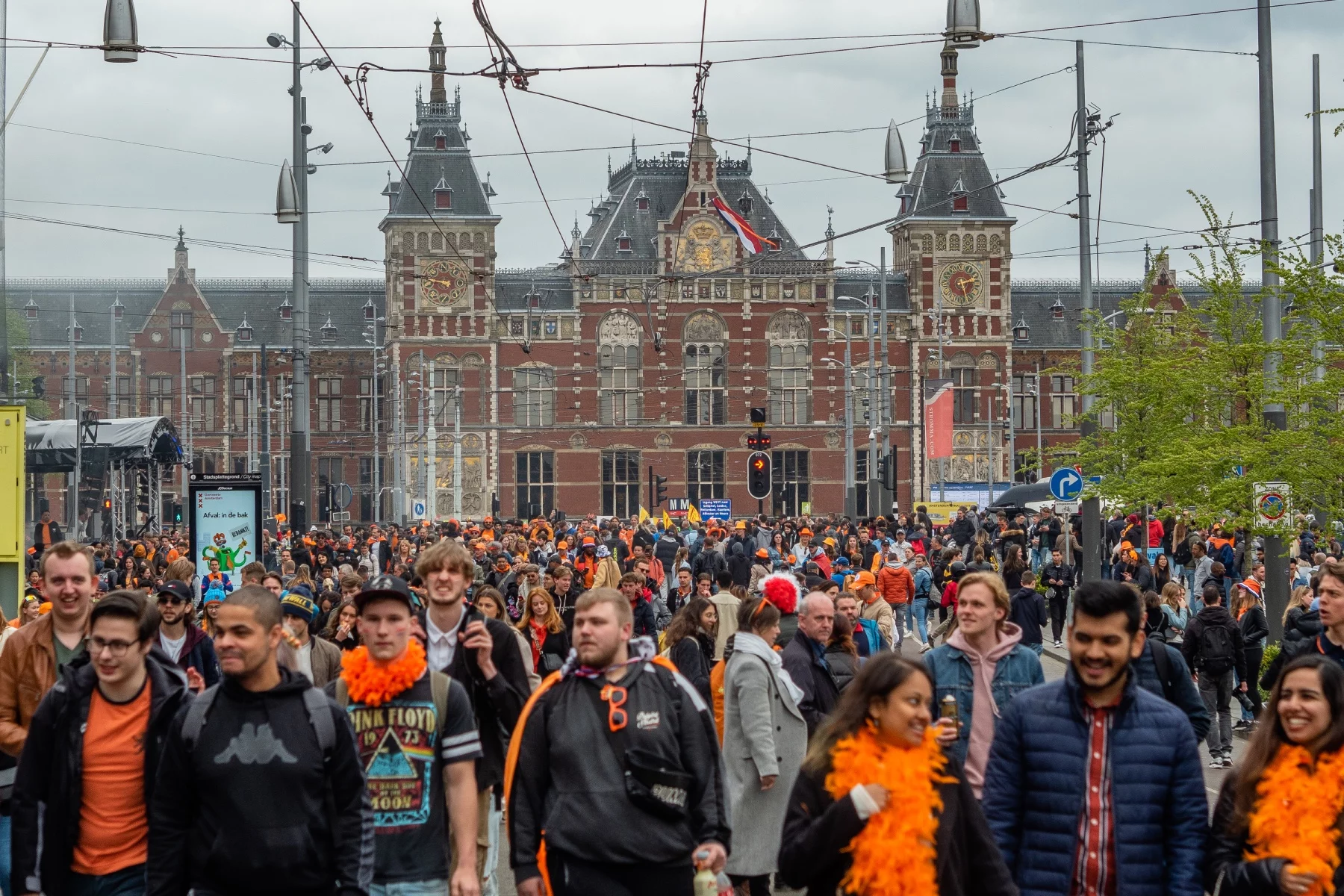
King's Day is known for street markets, orange clothing and large celebrations in many cities. For businesses, the practical effects are closures, disrupted public transport in city centres and reduced availability on the day.
Liberation Day
Liberation Day on 5 May marks the end of the German occupation in 1945. It is a recognised public holiday every year, but many CAOs give it as a paid day off only once every five years, in the so-called lustrum years ending in 0 and 5. Other agreements, particularly in the public sector, grant it every year. 2025 was a lustrum year; the next is 2030. In 2026 to 2029, many private-sector employees work on 5 May.
The evening before, 4 May, is Remembrance of the Dead, with a national two-minute silence at 8 p.m. It is not a public holiday.
Worked example: late April to mid-May 2027
Easter Sunday 2027 is 28 March. That puts Ascension on Thursday 6 May and Whit Monday on 17 May. King's Day, 27 April 2027, is a Tuesday. Liberation Day is Wednesday 5 May, not a lustrum year.
Take the four working weeks from Monday 26 April to Friday 21 May 2027: 20 weekdays.
| CAO with 5 May every five years | Terms with 5 May every year | |
|---|---|---|
| Weekdays, 26 April to 21 May | 20 | 20 |
| King's Day (Tue 27 Apr) | −1 | −1 |
| Liberation Day (Wed 5 May) | 0 | −1 |
| Ascension Day (Thu 6 May) | −1 | −1 |
| Whit Monday (17 May) | −1 | −1 |
| Working days | 17 | 16 |
In practice, availability will be lower still. Monday 26 April sits between a weekend and a Tuesday holiday, and Friday 7 May sits after Ascension. Both are common bridge days, and many Dutch schools have a spring break around this period. A four-week project phase starting on 26 April 2027 may realistically have fewer than 15 days with the full team present.
How many days off in 2027?
Because weekend holidays are not replaced, the number of days off varies from year to year. In 2027, Christmas Day and Boxing Day fall on a Saturday and Sunday, and Easter Sunday and Whit Sunday are Sundays by definition. That leaves these weekday holidays:
- New Year's Day: Friday 1 January
- Easter Monday: 29 March
- King's Day: Tuesday 27 April
- Ascension Day: Thursday 6 May
- Whit Monday: 17 May
That is five weekday holidays for an employee on a typical CAO. Add Liberation Day (Wednesday 5 May) where it is given every year, and Good Friday (26 March) where the employer gives it, and the figure rises to six or seven. Compared with a year in which Christmas falls midweek, an office worker in 2027 has two fewer holidays, which is worth knowing before setting annual targets.
Other days to know about
- Sinterklaas (5 December) is widely celebrated but is not a public holiday.
- Carnival is a major event in the southern provinces, and some employers there give time off, but it is not a public holiday.
- The Caribbean Netherlands (Bonaire, Sint Eustatius and Saba) have their own local days on top of the national list.
What to do next
- Check your CAO or contract for which holidays are paid days off, and in particular how it treats 5 May.
- Use the Netherlands holiday calendar and note whether King's Day has moved to 26 April.
- Look at the 2027 Dutch long weekends before planning anything in late April and May.
- Count delivery and notice deadlines with the business days calculator, set to the holidays your organisation actually gives.
- For international teams, read how holiday data is compiled on the methodology page.